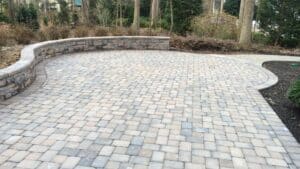

Most retaining wall installations at Green Side Up start at $2,000, with the final price set by the wall’s height and length, the material, site access, and the drainage it needs behind it.
How Retaining Walls Are Priced
Contractors structure wall pricing in a few different ways. Here is how the common models work and how Green Side Up approaches it.
Custom Project Scope (Green Side Up’s approach)
Green Side Up prices each wall by the full scope of the job: height, length, material, drainage, and how easily a crew can reach the site. The slope drives the number, not a flat per-foot rate.
Per Square Foot of Wall Face
Some firms price by the square footage of the wall face. It is quick to quote, but it can miss the drainage and base work a specific slope demands, which is where the real cost of a lasting wall sits.
Per Linear Foot
Others quote by the running foot of wall length. This tends to undercount taller walls, since a four-foot wall carries far more soil pressure, base, and reinforcement than a two-foot wall of the same length.
What Impacts Retaining Wall Pricing?
1. Wall Height
Taller walls hold back more soil, so they need a deeper base, more reinforcement, and sometimes an engineered plan. A short bed wall in Bon Air is a different job from a tall terraced wall on a Manakin Sabot slope.
2. Wall Length and Square Footage
A longer, taller wall face means more block or stone and more crew hours.
3. Material
Segmental block, natural stone, and poured concrete sit at different price points and give very different looks.
4. Site Access
A wall a machine can reach costs less than one where every stone is carried in by hand.
5. Slope and Grading
Steeper ground and more excavation add time, disposal, and cost.
6. Drainage
Gravel backfill and a drain line behind the wall are part of the price. Water with nowhere to go is what pushes walls over, so this is not a place to cut.
What a Retaining Wall Installation Includes
A wall is more than the face you see. A proper installation covers:
- Excavation and a compacted base
- A leveling pad sized to the wall
- The wall units themselves, block or stone
- Gravel backfill behind the wall
- A drain line to carry water away
- Reinforcement or geogrid on taller walls
- Cap units to finish the top
Most of that lives below grade, which is why a fair price reflects work you will never see once the wall is done.
Block vs. Natural Stone
The two most common choices sit at opposite ends of the range.
Segmental concrete block is the practical option for a durable wall at a reasonable cost. It is consistent, engineered for the job, and comes in a range of colors and textures. Natural stone and boulder walls cost more, both for the material and for the skill it takes to fit them, but nothing else reads quite the same on an estate property. Poured concrete is a structural choice, often faced with stone, used where a very strong wall is called for.
Why Building It Right Pays Off
A lower quote and a lasting wall usually are not the same job. Walls that lean, bow, or come apart a few years in tend to skip the parts you cannot see: a compacted base, gravel backfill, a drain line, and reinforcement sized to the height. Green Side Up gives you an estimate, prices a wall to hold for the long haul, and our stone and wall installations carry a 3-year warranty.
Get a Free Quote
The best way to get an accurate number is a site visit. Green Side Up Landscaping installs retaining walls across Virginia.
Schedule a free site visit and estimate today!
Frequently Asked Questions
How much does a retaining wall cost?
Retaining wall installations at Green Side Up start at $2,000. The final number depends on the wall’s height and length, the material, site access, and the drainage the wall needs.
What is the most affordable retaining wall material?
Segmental concrete block is usually the most economical choice for a wall that lasts. Natural stone costs more for the material and the labor.
Do I need a permit for a retaining wall?
Often, yes, for taller walls. Many localities require a permit and an engineered design once a wall passes a certain height, usually around three to four feet. We check local and HOA rules across Richmond and Williamsburg before the build.
Can a retaining wall fix a drainage or erosion problem?
Yes. A wall with proper backfill and a drain line behind it holds a slope in place and moves water away, which is why walls are a common fix for eroding or unusable hillsides.
How long does a retaining wall last?
A block or stone wall installed with the right base, drainage, and reinforcement can last decades. Lifespan drops fast when any of those steps is cut.
About the Author

Craig Attkisson is the Owner and General Manager of Green Side Up Landscaping, holding a B.S. in Agronomy and Horticulture from Virginia Tech. His passion for the outdoors started early — growing up on a Christmas tree farm and mowing baseball and soccer fields as a 10-year-old entrepreneur. That foundation led to hands-on experience at Hanover Country Club, followed by a unique opportunity during his time at Virginia Tech to study abroad in South Africa, researching cultural diversity, climates, agrometeorology, and large-scale irrigation. After returning to the U.S., Craig built his expertise across all three Country Club of Virginia golf courses before becoming Second Assistant Superintendent at Hermitage Country Club. In 2004, he channeled that deep-rooted knowledge into founding Green Side Up Landscaping — with a singular focus on delivering the best lawn care and landscaping service possible to every client.